The Arabist · Qur'an foundations & Arabic, taught in EnglishFirst cohort · starts mid-December 2026 · max 7 studentsAl-Asās · one-to-one · £12 an hour · children, teens & adults

Welcome to The Arabist

Where are you starting from?

Two programmes, one path. Choose yours to begin, and the page will take you through it.

↑ Pick one to continue

Samiul Islam

Who we are

I'm Samiul Islam (Abū Amānah). I teach Qur'an foundations and Arabic in English, for the people I once was: adults who started and stopped, and children who deserve to read properly from the start.

About me and how we teach →
1Stage 1 of 6 · Your story
Al-Jisr · Your Bridge into Arabic

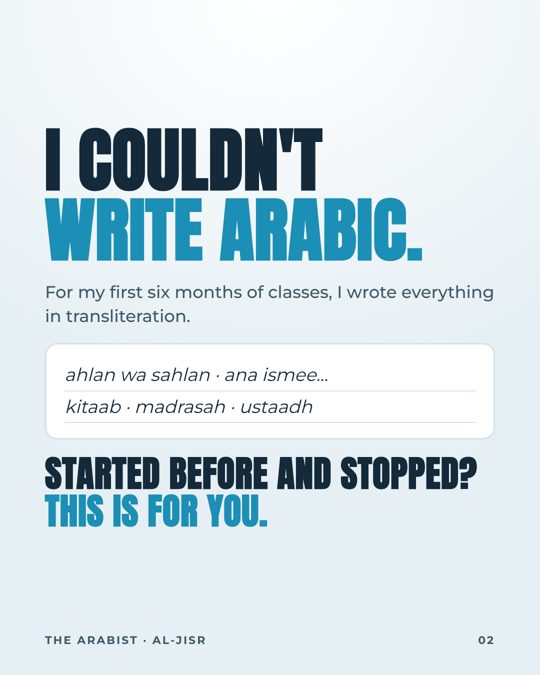
I couldn't write Arabic.

For my first six months of classes I wrote everything in transliteration. If you've started Arabic before and stopped, this is for you.

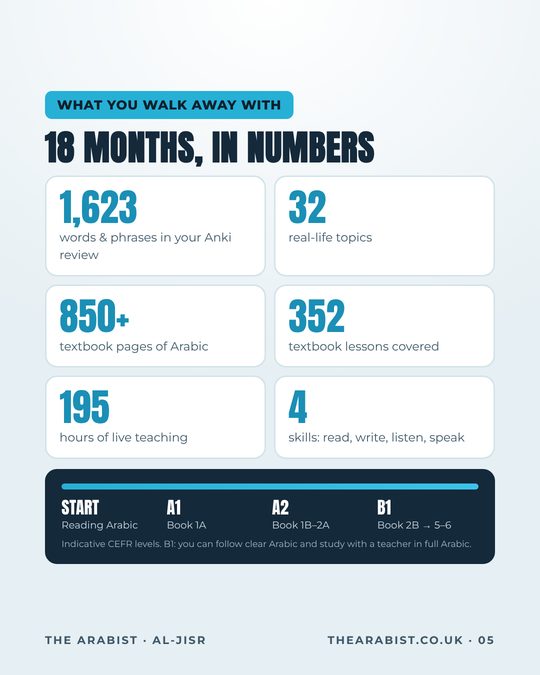
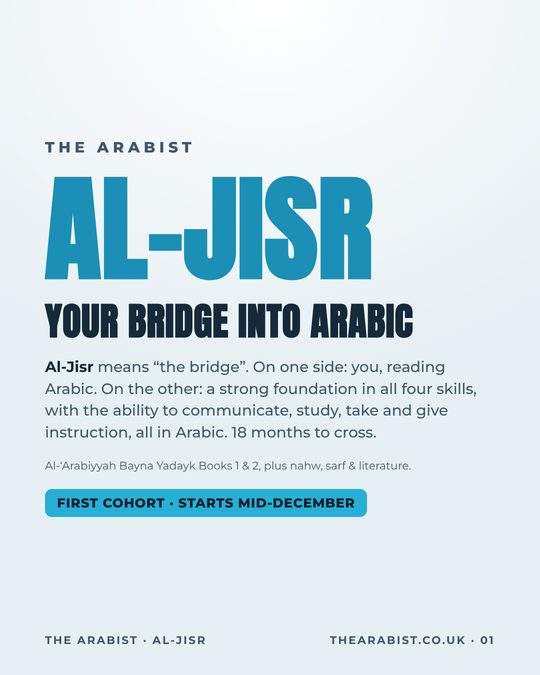
Al-Jisr means “the bridge”. On one side: you, reading Arabic. On the other: a strong foundation in all four skills, with the ability to communicate, study, take and give instruction, all in Arabic. 18 months to cross.

Not ready to book? Leave your detailsTakes 30 seconds. I'll get in touch, no pressure. Prefer to read it all at once?Download the 12-page brochure (PDF)
Bayna Yadayk Books 1 & 2Taught in EnglishMon & Thu evenings, online1-2-1 mentorship
Sound familiar?

Started before and stopped?

Most people start Arabic for the same reason: to understand their prayers, the khutbah and the Quran. Most people stop for the same three reasons.

01

The class moved too fast.

You fell behind once, and catching up felt impossible.

02

You couldn't follow the explanations.

Grammar taught in Arabic you didn't have yet.

03

Nobody was there between lessons.

No plan, no one checking in. YouTube doesn't hold you to account.

It doesn't have to go that way again.

Samiul Islam, founder of The Arabist
Founder's note

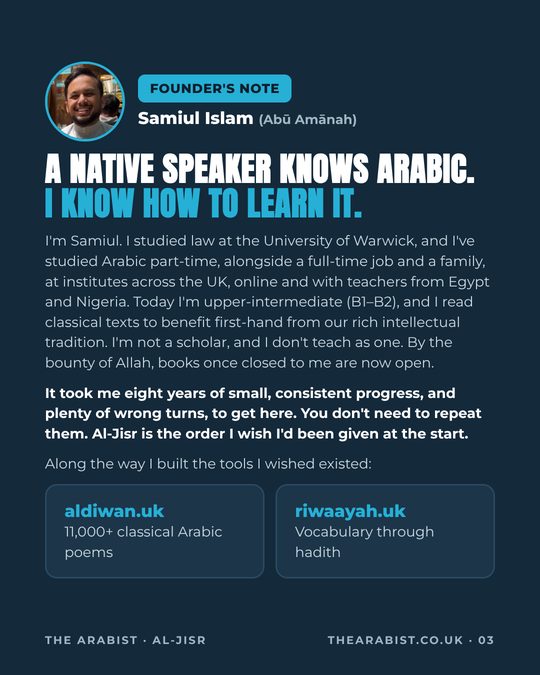
A native speaker knows Arabic. I know how to learn it.

I'm Samiul Islam (Abū Amānah). I studied law at the University of Warwick, and I've studied Arabic for 8+ years, all of it part-time, alongside a full-time job and a family. For my first six months of classes, I couldn't write Arabic.

Today, by the bounty of Allah, I'm upper-intermediate (B1–B2) and read classical texts to benefit first-hand from our rich intellectual tradition. I'm not a scholar, and I don't teach as one. Al-Jisr is the order I wish I'd been given at the start.

Read my full story

Arabic is my third language. Since those first classes I've studied at institutes across the UK, online, and with private teachers from Egypt and Nigeria, in groups and one-to-one. I've made most of the common mistakes: wrong books, wrong order, wrong methods. I have a background in Islamic studies, and books that were once closed to me are now open.

Along the way I started building the tools I wished existed: Al-Dīwān for classical poetry, Riwāyah for vocabulary through hadith, and The Arabist on Telegram for the resources I actually use.

It took me eight years of small, consistent progress, and plenty of wrong turns, to get here. You don't need to repeat them.

It's taught in English by someone who started where you are, with a clear plan and someone holding you to account. My aim is to get you to the point where you can sit with teachers who teach only in Arabic, and keep going on your own. When you're ready, I can introduce you to some of my own teachers and to mashāyikh from al-Azhar.

Samiul Islam (Abū Amānah) · More about me →

2Stage 2 of 6 · The journey
The journey

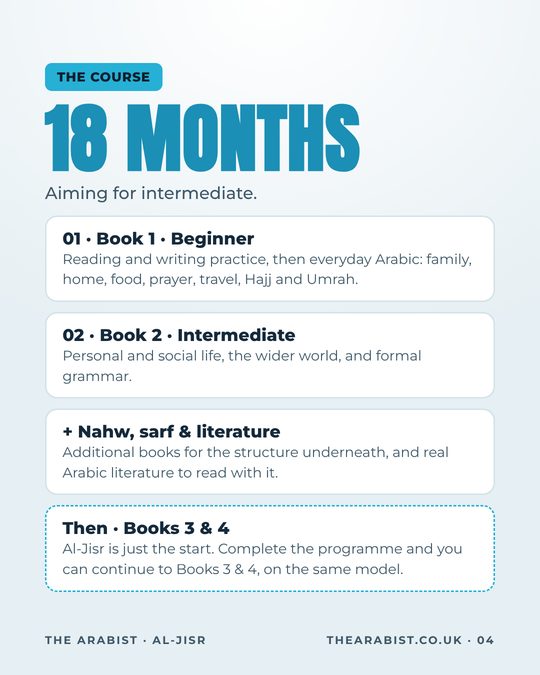
Cross the bridge in 18 months

Six modules, one step at a time. Scroll to walk it.

YOU READING ARABIC Ahl al-‘Ilm PEOPLE OF KNOWLEDGE
StartYou, reading Arabic
The near bank

You, reading Arabic

Start

You can read Arabic script, even slowly. That's all you need to step on. Can't read yet? A private foundation course gets you there first: letters, writing and correct pronunciation.

Module 1 · Months 1–3

Book 1, Part A

A1

Reading and writing practice, then everyday Arabic: greetings, family, home, daily life, food, prayer, study and work.

Module 2 · Months 4–6

Book 1, Part B

A1 → A2

Shopping, weather, travel, Hajj and Umrah, health and holidays. Your first use of the past tense.

Module 3 · Months 7–9

Book 2, Part A

A2

Personal and social life. Formal grammar begins: sentence types, case endings, كان and its sisters.

Module 4 · Months 10–12

Book 2, Part B

A2 → B1

Society and the wider world. The full case system, إنّ and its sisters, الحال and التمييز.

Modules 5–6 · Months 13–18

Nahw, sarf & literature

B1

Separate grammar and morphology texts for the structure underneath, and real Arabic literature to read with it.

The other side

Ahl al-‘Ilm

Across

A strong foundation in all four skills, with the ability to communicate, study, take and give instruction, all in Arabic. When you're ready, I'll connect you with teachers who teach only in the Arabic medium. And Al-Jisr is just the start: Books 3 & 4 continue on the same model.

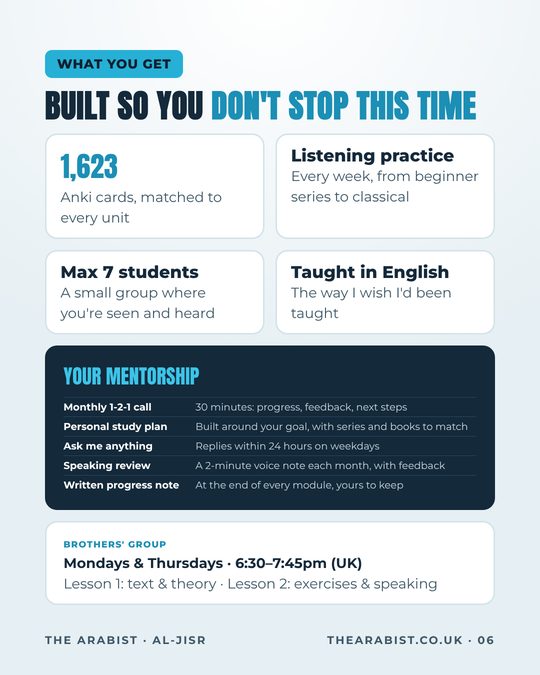
Mon & Thu6:30–7:45pm (UK), live online
2 × 1h15a week: theory, then speaking
Max 7students · brothers' group
195 hoursof live teaching in 18 months

The honest part: intermediate in 18 months takes full commitment: every class, taking part, and disciplined self-study between lessons. I'll tell you what to study, how much, and in what order.

3Stage 3 of 6 · What you get
What you get

More than a class

Everything here is included in every module. Pick a tab.

You're not just a seat in a class

Like a university tutor, but for your Arabic: someone who knows where you are and notices when you drift.

  1. Monthly 1-2-1 progress call30 minutes, every month: where you are, what's working, what to fix next.
  2. Your personal study planBuilt around your goal: Quran, classical texts, conversation or teaching your children.
  3. Ask me anythingAny question, by text or voice note. Replies within 24 hours on weekdays.
  4. Monthly speaking reviewSend a 2-minute voice note and get specific feedback on pronunciation and fluency.
  5. Written progress noteAt the end of every module: what's strong, what to fix, what's next. Yours to keep.
Want me to talk you through the price?

Leave your name and number and I'll get back to you. No commitment.

Leave your details
4Stage 4 of 6 · Price
Price

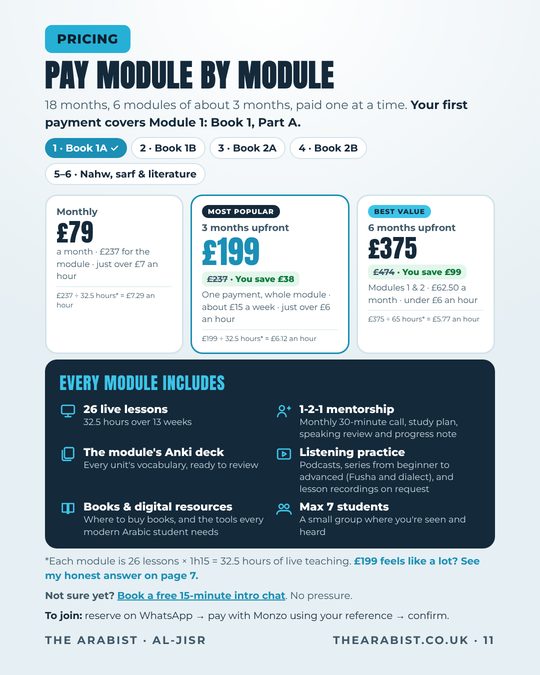
Pay module by module

Pay one module at a time, starting with Book 1, Part A, or save by paying for 6 months. No 18-month commitment.

Most popular
£199 for 3 months
£237 if paid monthly · You save £38
One payment covers the whole module (Book 1, Part A). This is not a monthly fee.
≈ £15 a weekjust over £6 an hour≈ £66 a month

How it works out: 26 lessons × 1h15 = 32.5 hours of live teaching. £199 ÷ 32.5 hours = £6.12 an hour.

  • 26 live lessons of 1h15 (32.5 hours)
  • Saves £38 compared with paying monthly
  • Mentorship, Anki decks and listening included
Pay £199 with Monzo
2-WEEK
GUARANTEE

Try it, risk-free

Join for the first two weeks. If it isn't right for you, message me and I'll refund you in full, no awkward conversation.

Reserve first on WhatsApp so I can send your student reference.

Can't afford it? Message me privately and we'll work something out. Money should never be a barrier to knowledge.

£199 feels like a lot? Read my honest answer →
What's included in every module
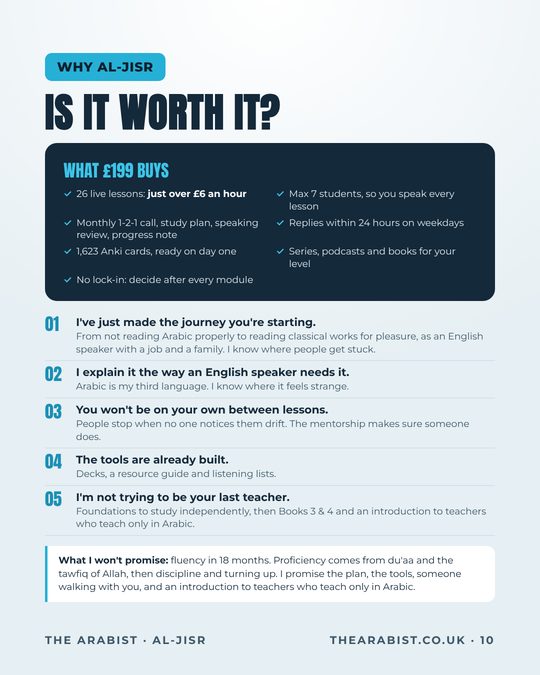
  • 26 live lessons of 1h15 each (32.5 hours in total)
  • A group of no more than 7, so you speak every lesson
  • A monthly 1-2-1 call and your own study plan
  • A monthly speaking review and a written progress note
  • Replies to your questions within 24 hours on weekdays
  • 1,623 Anki cards, matched to every unit
  • Series, podcasts and books chosen for your level
  • No lock-in: you decide after every module

What I won't promise: fluency in 18 months. Proficiency comes from du'aa and the tawfiq of Allah, then discipline and turning up. What I can promise is the plan, the tools and someone walking with you.

TodayModule 1 only (or 1 & 2 for £375)
After 3 monthsYou decide: continue or stop
Each modulePay as you reach it
After 18 monthsBooks 3 & 4, if you wish
5Stage 5 of 6 · Join
Join

Four steps to your place

Not sure yet?

Book a free, relaxed 15-minute chat on Google Meet first. We'll get to know each other, talk about your goals and the course, and read a short paragraph together so I can suggest the right starting point. No pressure, no obligation.

1

Reserve on WhatsApp

Message me and I'll send your student reference.

2

Pay with Monzo

Use your reference, e.g. ABYB1B218-01.

3

Confirm your payment

Tap “I've paid” below and I'll confirm the same day.

4

Get access

Class link, group invite and your Anki decks.

Groups are capped at 7. Reserving a place means you agree to the course terms.

Prefer a private class?

One-to-one, your own group of 3+, or Al-Asās, our one-to-one foundation course in reading, writing and tajwīd.

Ask about private classes
6Stage 6 of 6 · Questions
Questions

Your questions, honestly answered

Getting started

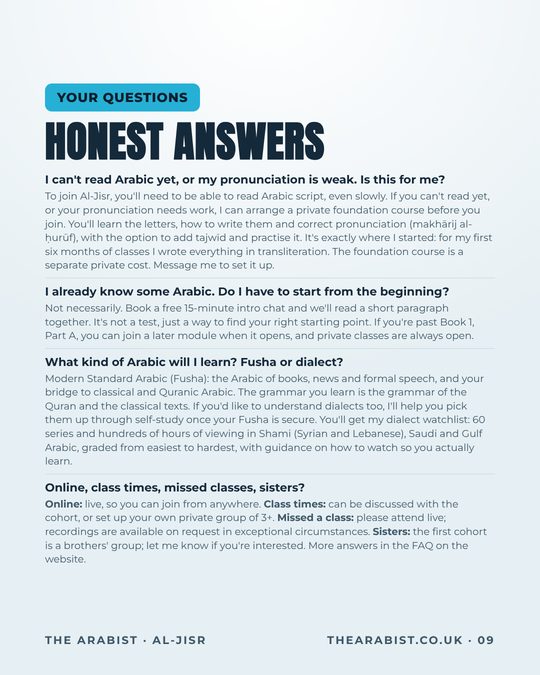
I can't read Arabic yet, or my pronunciation is weak. Is this for me?

To join Al-Jisr, you'll need to be able to read Arabic script, even slowly. If you can't read yet, or your pronunciation needs work, you can start with Al-Asās, my one-to-one foundation course, before you join. You'll learn the letters, how to write them and correct pronunciation (makhārij al-ḥurūf), with the option to add tajwīd and practise it. It's exactly where I started: for my first six months of classes I wrote everything in transliteration. Al-Asās is £12 an hour, paid month to month. Message me to set it up, or book a free 15-minute intro chat and we'll work out the right starting point together.

I already know some Arabic. Do I have to start from the beginning?

Not necessarily. Let's check: book a free 15-minute intro chat. We'll read a short paragraph together, and I'll get a feel for your reading, pronunciation and understanding. It's not a test, just a way to find your right starting point. If you're past Book 1, Part A, you can join a later module when it opens. Private classes are also always open, with a programme tailored to your level and goals. If you're unsure, starting at Module 1 is rarely wasted: most people who 'know some Arabic' have gaps in the basics that hold them back later.

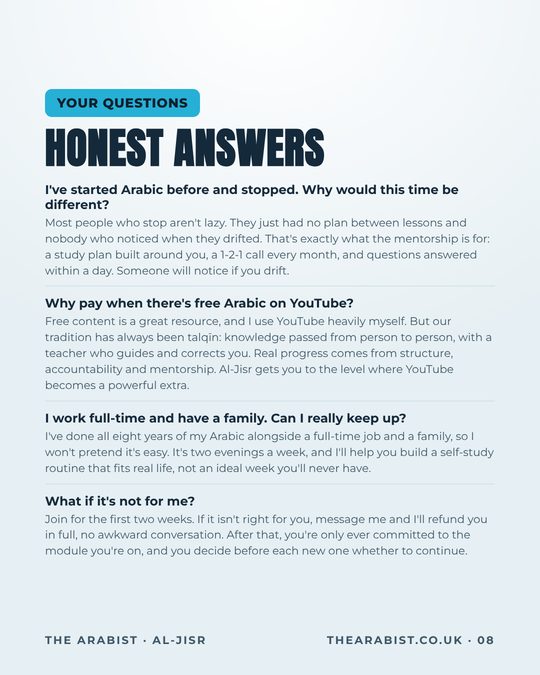
I've started Arabic before and stopped. Why would this time be different?

Most people who stop aren't lazy. They just had no plan between lessons and nobody who noticed when they drifted. That's exactly what the mentorship is for: a study plan built around you, a 1-2-1 call every month, and questions answered within a day. Someone will notice if you drift.

I work full-time and have a family. Can I really keep up?

I've done all eight years of my Arabic alongside a full-time job and a family, so I won't pretend it's easy. It's two evenings a week, and I'll help you build a self-study routine that fits real life, not an ideal week you'll never have.

How much time do I need outside class?

As a general guide, one hour of revision for every hour of class: about 2.5 hours a week on top of the two lessons. Spread it out with Anki most days, the homework and some listening. The more you put in, the better, but little and often beats one long session, and your study plan will be built around the time you actually have.

Is it for brothers and sisters?

The first cohort is a brothers' group. Sisters, if you're interested, please let me know on WhatsApp. If there's enough demand, I'll be happy to set up a sisters' group too.

Can my child or teenager join?

The group course is for adults (18+). For anyone under 18, I can arrange private online classes with a parent's agreement, on the same pathway, tailored to the student's level. If they're still learning to read, Al-Asās is the place to start. Message me to set it up.

The course

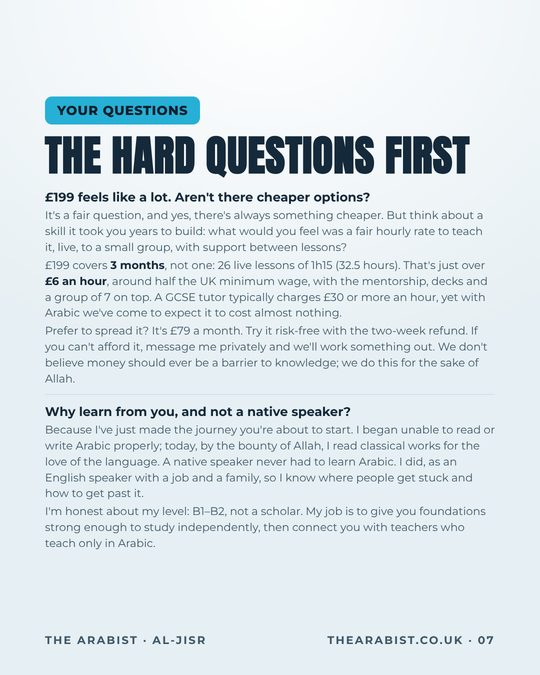
Why learn from you, and not a native speaker?

Because I've just made the journey you're about to start. I began unable to read or write Arabic properly; today, by the bounty of Allah, I read classical works for the love of the language. A native speaker never had to learn Arabic. I did, as an English speaker with a job and a family, so I know exactly where people get stuck and how to get past it.

I'm honest about my level: I'm B1–B2, not a scholar. And that's the point. I'm not trying to be your last teacher. My job is to give you foundations strong enough to study independently, then connect you with Arabic teachers who teach only in the Arabic medium, and with the scholars directly.

What kind of Arabic will I learn? Fusha or dialect?

Modern Standard Arabic (Fusha): the Arabic of books, news and formal speech, and your bridge to classical and Quranic Arabic. The grammar you learn is the grammar of the Quran and the classical texts.

If you'd like to understand dialects too, I'll help you pick them up through self-study once your Fusha is secure. You'll get my dialect watchlist: 60 series and hundreds of hours of viewing in Shami (Syrian and Lebanese), Saudi and Gulf Arabic, graded from easiest to hardest, with guidance on how to watch so you actually learn.

Will this help me understand the Quran?

That's why most of us start, and it's why I did. This course builds the foundations: reading, grammar and core vocabulary, much of it in an Islamic context. Understanding the Quran deeply is a lifelong journey; this gets you onto it properly, with the tools to keep going.

Will I really reach intermediate in 18 months?

Only if you put the work in, and I'd rather tell you that now. Turn up, do the self-study I set, and you'll be able to sit with a teacher who teaches only in Arabic and follow along. There's no finish line in Arabic, but there is a point where you can carry on by yourself. That's the goal.

What happens after the 18 months?

Al-Jisr is just the start. Once you've successfully completed the programme, you can continue with Books 3 & 4, and your Anki decks for those books are already built. Or, if you're ready, I'll connect you with Arabic teachers who teach only in the Arabic medium.

What if I fall behind?

Then we slow down and fix it, not move on without you. In your monthly 1-2-1 we'll find exactly where it slipped, and I'll adjust your study plan around it. Lesson recordings (on request) and the Anki decks mean you can always go back over a unit. If a module turns out to be too fast for you, you can repeat it with the next cohort rather than push on and struggle.

What if I miss a class?

Please attend live wherever you can: that's where most of the learning happens. But life happens, so every lesson is recorded. If you miss one in exceptional circumstances, the recording is available on request, along with the homework and the unit's Anki deck, so you can catch up before the next class. If something doesn't click, message me and I'll go through it with you, or we'll cover it in your monthly 1-2-1. And if you miss a few in a row, I'll check in, not to chase you, but to help you get back on track.

Do I need to buy the books?

No. I'll send you the PDFs of the books we use, along with the audio recordings that go with them. If you'd prefer printed copies, I can share a link to buy the full series at a competitive rate.

Price & money

£199 feels like a lot. Aren't there cheaper options?

It's a fair question, and yes, there's always something cheaper.

But think about something you're passionate about, a skill it took you years to build. What would you feel was a fair hourly rate to teach it, live, to a small group, and to check in on each person between lessons?

Here's what Al-Jisr actually works out at:

  • £199 covers 3 months, not one: a whole module.
  • That's 26 live lessons of 1h15, or 32.5 hours of teaching.
  • That comes to just over £6 an hour, around half the UK minimum wage.
  • On top of that: a monthly 1-2-1 call, your own study plan, speaking reviews, progress notes, 1,623 Anki cards, and a group of no more than 7.

A GCSE maths or English tutor typically charges £30 or more an hour. Yet when it comes to Arabic, we've come to expect it to cost almost nothing. Teachers abroad can charge less because their living costs are lower, and that's fair for them. But it isn't a like-for-like comparison with live teaching in English, from someone who learned Arabic the way you're about to.

Prefer to spread it? It's £79 a month instead. Or pay £375 for six months and save £99.

You're not taking a risk: if it isn't right for you in the first two weeks, I'll refund you in full.

If you can't afford it, message me privately and we'll work something out. At The Arabist, we don't believe money should ever be a barrier to knowledge. We do this for the sake of Allah.

Why pay when there's so much free Arabic on YouTube?

Free content is a great resource, and I use YouTube heavily myself. But our tradition has always been one of talqīn: knowledge passed from person to person, with a teacher who guides and corrects you. If watching videos were enough on its own, it would already have worked for most of us.

Real progress comes from structure, accountability and mentorship. And it takes a certain level of discipline and Arabic before YouTube becomes truly useful. Al-Jisr gets you to that point, and from there, it becomes a powerful extra.

What if it's not for me?

Join for the first two weeks. If it isn't right for you, message me and I'll refund you in full, no awkward conversation. After that, you're only ever committed to the module you're on, and you decide before each new one whether to continue. If you pay monthly, the 3 instalments cover the module you're on, so they're still due if you stop part-way through it. Nothing is owed for later modules.

Is paying by Monzo safe? Will I get a receipt?

Yes. A Monzo link is a secure bank payment, and you don't need a Monzo account to use it: you can pay with a debit card. Use your student reference so I can match your payment, and I'll confirm receipt on WhatsApp the same day, with a written receipt for your records.

Practical

Is it online or in person?

Online, live, so you can join from anywhere. The exact platform and joining details will be confirmed closer to the start date.

I'm outside the UK. Can I join?

Yes. Classes are online, so you can join from anywhere. Lessons run on UK time (Mondays and Thursdays, 6:30–7:45pm), so check how that falls in your time zone. If it doesn't work, see the question on class times: we can look at the timing with the cohort, or set up a private group. If you can't pay with a UK bank, alternative payment methods are available. Contact me for more information.

The class times don't work for me. What can I do?

Let me know. Times can be discussed with the cohort, and if a different slot works better for the group, we'll agree one together. Or, if you have at least 3 people, you can set up your own private group at a time that suits you. Message me privately to arrange it.

When does it start?

The first cohort starts in mid-December, and I'll confirm the exact date to everyone who reserves a place. Groups are capped at 7, so places go in the order they're reserved.

I'm still not sure.

Message me anyway, or book a free 15-minute intro chat. I'll tell you honestly whether this course is right for you, and if it isn't, I'll point you to something that is.

Progress comes from du'aa and tawfiq from Allah, then discipline, turning up, and guidance from someone who's walked the path.

I build the bridge.
The journey is yours.

When you're ready to study fully in Arabic, I can introduce you to some of my own teachers, with years of experience in marākiz and private teaching, and to mashāyikh from al-Azhar for private study in the Islamic sciences.

Not ready to book? Leave your details and I'll get in touch → The full course in 12 pagesDownload the brochure to read later or share with someone who'd benefit
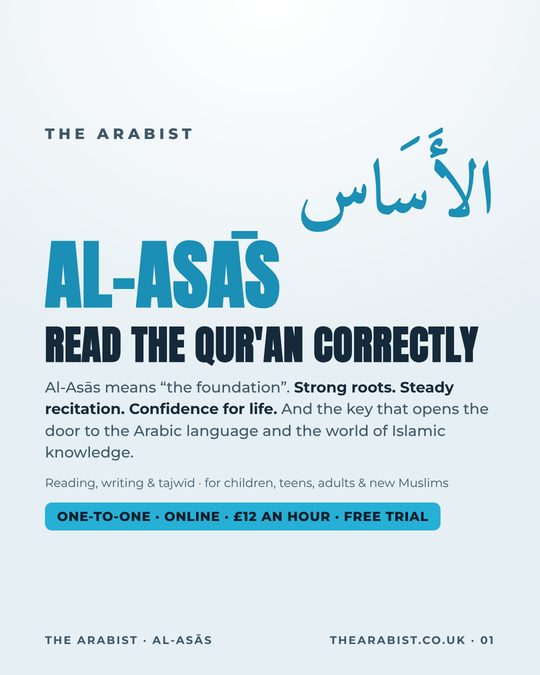
1Stage 1 of 6 · Why Al-Asās
Al-Asās · The Foundation

Read the Qur'an correctly.

Back to basics: reading, writing and tajwīd, taught one-to-one and online, so it fits around school, work and family. For children, teenagers, adults who want a refresher, and anyone starting from zero.

Al-Asās means “the foundation”. Strong roots. Steady recitation. Confidence for life. And the key that opens the door to the Arabic language and the world of Islamic knowledge.

Not ready to book? Leave your detailsTakes 30 seconds. I'll get in touch, no pressure.
One-to-oneGuided & tailoredOnline, flexible times£12 an hourFree trial lesson
الأَسَاسAl-Asās · The Foundation
  1. ReadAhsan al-Qawā'id, letter by letter
  2. WriteSafar Arabic Handwriting, alongside
  3. TajwīdSafar Rules of Tajwīd, in seven levels
  4. ApplyEvery rule across Juz 'Amma, then any page
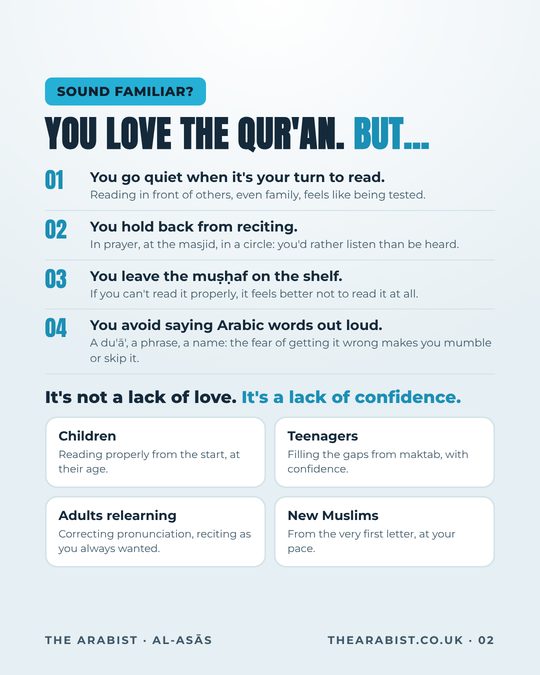
Sound familiar?

You love the Qur'an. But…

01

You go quiet when it's your turn to read.

Reading in front of others, even family, feels like being tested.

02

You hold back from reciting.

In prayer, at the masjid, in a circle: you'd rather listen than be heard.

03

You leave the mushaf on the shelf.

Because if you can't read it properly, it feels better not to read it at all.

04

You avoid saying Arabic words out loud.

A du'ā', a phrase, a name: the fear of getting it wrong makes you mumble or skip it.

The good news: this is very fixable.

Pronunciation and fluency can be corrected significantly in as little as six months, with commitment, dedication and the right guidance. All that's missing is the right foundations.

Who it's for

Anyone starting from the foundations

Children

Learning to read properly from the start, with lessons pitched at their age.

Teenagers

Filling the gaps from maktab and reading with confidence.

Adults relearning

Correcting pronunciation and reciting the way you always wanted to.

New Muslims

Starting from the very first letter, patiently and at your pace.

Samiul Islam, your Al-Asās teacher
Your teacher

I used to avoid the Qur'an.

I'm Samiul Islam (Abū Amānah). Like many of us, I went to maktab from the age of 5 to 14, and came out of it feeling distant from the Qur'an and from my religion. I didn't have the confidence to read it properly, and I didn't understand its language. I felt like a tourist in my own religion, relying on whatever was passed on to me, without being able to check it myself.

In my late teens I started again. I studied tajwīd and makhārij al-ḥurūf with teachers, correcting how I pronounced every letter, and relearning gave me back the confidence to open the mushaf and recite.

Why I teach Al-Asās

Not being able to read, or not being able to read fluently, is one of the most common problems in our community, and it keeps us at a distance from the Book that's meant to be at the centre of our lives.

Since then I've gone on to study the Arabic language, I have a background in Islamic studies, and I teach Arabic. I'm passionate about helping people build the confidence I once didn't have.

At the very least, Al-Asās gets you reciting properly. At its best, it puts you in a position to go further: to study the Arabic language and really understand the words of Allah.

Samiul Islam (Abū Amānah) · More about me →

It's not a lack of love.
It's a lack of confidence.

That's what keeps so many of us away from the Qur'an, and from ever engaging directly with its language. Without the foundations, seeking knowledge feels out of reach. Get the foundations right, and the door to knowledge opens. And what we learn is what shapes how we live.

2Stage 2 of 6 · What you'll learn
The course

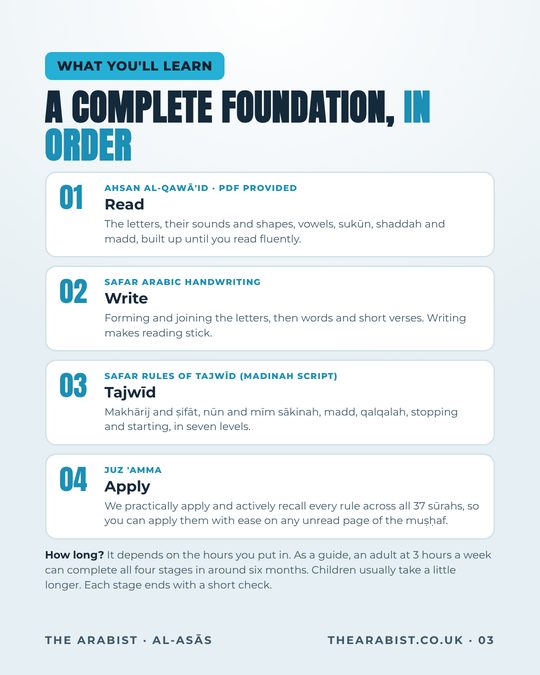
A complete foundation, in order

01
Ahsan al-Qawā'id · PDF provided

Read

The letters, their sounds and shapes, vowels, sukūn, shaddah and madd, built up lesson by lesson until you read fluently.

By the end: Any page of the muṣḥaf, fluently

02
Safar Arabic Handwriting

Write

Alongside the Qā'idah: forming and joining the letters, then words and short verses. Writing makes reading stick.

By the end: Every letter, in every form

03
Safar Rules of Tajwīd (Madinah Script)

Tajwīd

Makhārij, nūn and mīm sākinah, madd, qalqalah, and stopping and starting, in seven progressive levels.

By the end: Each letter from its true place

04
Juz 'Amma

Apply

We practically apply and actively recall every tajwīd rule across all 37 surahs of Juz 'Amma, corrected as you go, so you can apply them with ease on any unread page of the muṣḥaf.

By the end: Every rule, on any page of the muṣḥaf

See every goal, in detail

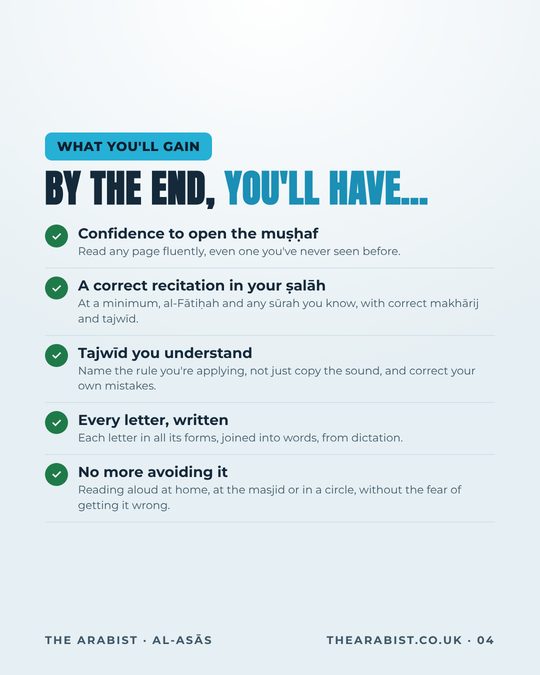
Read

  • Recognise all 29 letters in every form: alone, beginning, middle and end
  • Read every vowel and sign without spelling out: tanwīn, sukūn, shaddah, madd, hamzah
  • Read sun and moon letters and the connecting hamzah correctly
  • Read an unseen page of the muṣḥaf steadily

Write

  • Write every letter in all its forms, and join them into words
  • Write short words from dictation and copy an āyah neatly

Tajwīd

  • Pronounce each letter from its correct point (makhārij) with its qualities (ṣifāt)
  • Apply the core rules: nūn and mīm sākinah, qalqalah, ghunnah, madd, heavy and light letters
  • Stop and start correctly, using the signs in the muṣḥaf
  • Name the rule you are applying, not just copy the sound

Apply

  • Practically apply and actively recall every tajwīd rule across the whole of Juz 'Amma
  • Apply those rules with ease on any page of the muṣḥaf, even one you've never read
  • At a minimum, recite al-Fātiḥah and any sūrah you have memorised with correct makhārij and tajwīd
  • Spot and correct your own mistakes

Each stage ends with a short check, so you always know where you stand.

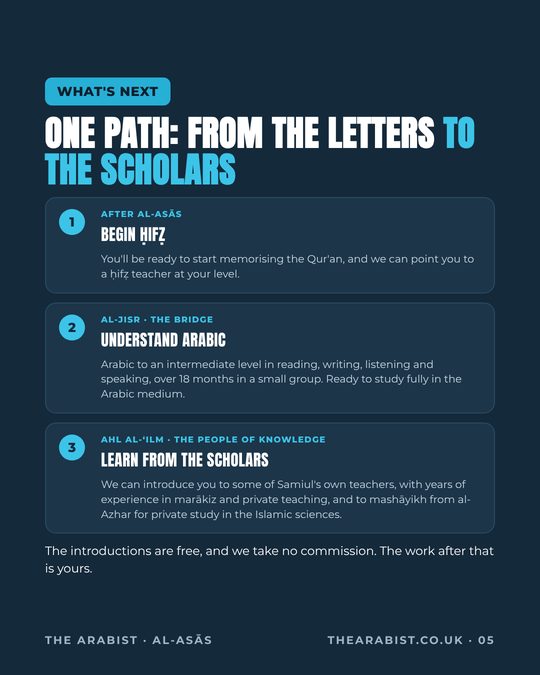
Where it leads

Ḥifẓ with a teacher at your level, or Arabic with Al-Jisr and, from there, the scholars.

See where it leads
Ḥifẓ

You'll be ready to start memorising the Qur'an, and I can point you to a ḥifẓ teacher at your level.

Arabic

The next step is Al-Jisr: Arabic to an intermediate level in all four skills, ready to study fully in the Arabic medium. From there, I can introduce you to some of my own teachers and to mashāyikh from al-Azhar.

Prefer to read it all at once?Download the 7-page Al-Asās brochure (PDF)

How long? It depends on the hours you put in. As a guide, an adult at 3 hours a week can complete all four stages in around six months. Children usually take a little longer.

Included: the Qā'idah PDF, notes and guidance between lessons. You buy two books from Safar Publications' official website, and I'll help you order the right editions.

3Stage 3 of 6 · One-to-one
Why one-to-one

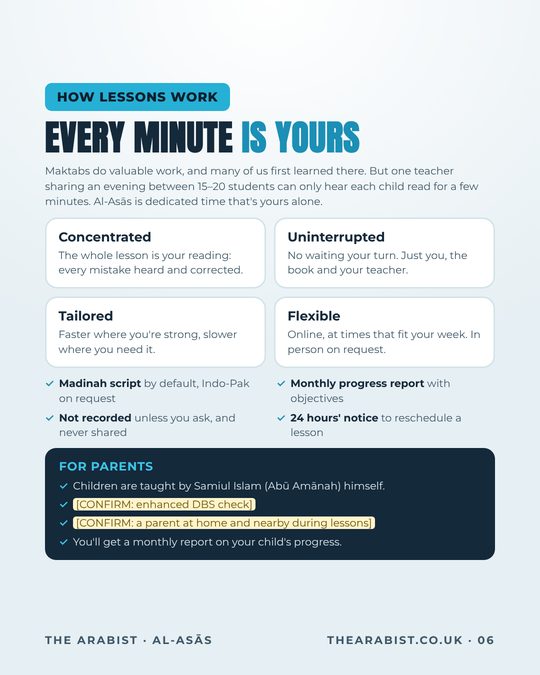
Every minute is yours.

Maktabs do valuable work in our communities, and many of us first learned to read there. But one teacher sharing an evening between 15–20 students, and between Qur'an, fiqh, sīrah and du'ā', can only hear each child read for a few minutes. Al-Asās is the other half: dedicated time that's yours alone.

Concentrated

Every mistake heard and corrected.

Uninterrupted

No waiting your turn. Just you and the book.

Tailored

Your pace, not the group's.

Flexible

Online, at times that fit around school, work and family.

4Stage 4 of 6 · Price
Price

Simple, month to month

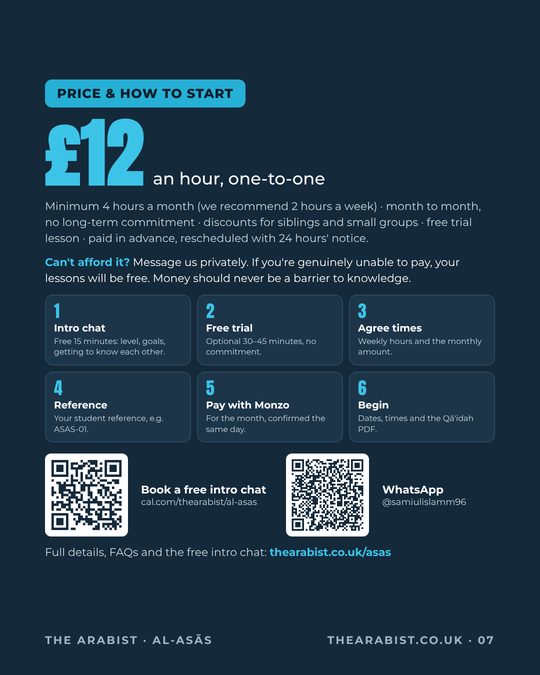
£12 an hour, one-to-one
  • Minimum 4 hours a month
  • Pay month to month: no long-term commitment, decide each month
  • Siblings and small groups: discounted rates
  • Qā'idah PDF, homework, resources and guidance between lessons
  • A monthly progress report, with objectives for the student
  • Free trial lesson (30–45 minutes), with no commitment

We recommend at least 2 hours a week. Regular lessons stop the gaps where things are forgotten, and that's where good progress comes from.

Can't afford it?

Message me privately. If you're genuinely unable to pay, your lessons will be free of charge.

At The Arabist, we don't believe money should ever be a barrier to knowledge. We do this for the sake of Allah.

Message me privately
Not sure how many hours you need?

Leave your name and number and I'll get back to you. No commitment.

Leave your details
5Stage 5 of 6 · Start
Start

From first chat to first lesson

1

Intro chat & consultation

A free 15 minutes: your level, your goals and hopes, and getting to know each other.

2

Free trial lesson

Optional: 30–45 minutes to try it, with no commitment.

3

Agree times & price

Your weekly hours (minimum 4 a month) and the monthly amount, based on your circumstances.

4

Get your reference

I'll send your student reference, for example ASAS-01.

5

Pay with Monzo

Pay for the month using your reference. I'll confirm the same day, with a receipt.

6

Confirm slots & begin

Your lesson dates and times, Qā'idah PDF and book links. The journey begins.

Not ready to book? Leave your details and I'll get in touch →

Ready to pay for your month?

Once we've agreed your hours and amount, pay with Monzo using your student reference, then let me know so I can confirm your slots.

Lessons are online. In-person lessons can be considered on request, depending on location. Booking lessons means you agree to the Al-Asās terms.

6Stage 6 of 6 · Questions
Questions

Your questions, honestly answered

About Al-Asās

What is Al-Asās, and who is it for?

Al-Asās is a one-to-one foundation course in reading the Qur'an, writing Arabic and tajwīd. It's for three kinds of student: children and teenagers learning to read properly, adults who want a refresher and to correct their recitation, and anyone who knows nothing yet but wants to learn, including new Muslims.

The aim is a solid foundation, and from there, a route into Al-Jisr, our Arabic language programme, so you can go on to understand what you recite.

Are you qualified to teach tajwīd?

I studied tajwīd and makhārij al-ḥurūf with teachers to correct my own recitation, I have a background in Islamic studies, and I have experience teaching the Arabic language. Al-Asās teaches the foundations: reading fluently, writing, and the core rules of tajwīd applied to Juz 'Amma. If you later want to go further in tajwīd, I'm happy to point you towards teachers who specialise in it.

Do I need to know any Arabic first?

No. We can start from the very first letter. If you already read a little, we'll start wherever you are.

What will I be able to do by the end?

Read any page of the muṣḥaf fluently, write the letters in all their forms, pronounce each letter correctly with its makhārij and ṣifāt, and practically apply and actively recall every tajwīd rule across the whole of Juz 'Amma, and, at a minimum, recite al-Fātiḥah and any sūrah you've memorised with correct makhārij and tajwīd. That practice is what lets you apply the rules with ease on any unread page of the muṣḥaf. Each stage ends with a short check, so you always know where you stand. See the full list ↑

How long does it take?

It depends on the hours you put in. As a guide, an adult at 3 hours a week can complete all four stages in around six months; at 2 hours a week, closer to nine. Children usually take a little longer. Regular lessons matter more than long ones.

What happens after Al-Asās?

Once you can read confidently, write and recite with tajwīd, you choose your path. Ḥifẓ: you'll be ready to start, and I can point you to a teacher at your level. Arabic: the next step is Al-Jisr, 18 months in a small group that take you to an intermediate level in reading, writing, listening and speaking, ready to study fully in the Arabic medium. At that point I can introduce you to some of my own teachers, who are reputable and have years of experience teaching in marākiz and privately, and to mashāyikh from al-Azhar for private study in the Islamic sciences.

Price & payment

How much does it cost, and is there a commitment?

£12 an hour, one-to-one. The minimum is 4 hours a month, and you pay month to month, in advance, with no long-term commitment: you decide each month whether to continue. To see good progress, I recommend at least 2 hours a week. Full details are in the Al-Asās terms.

Can I try a lesson first?

Yes. Your first lesson is a free trial of 30–45 minutes, with no commitment. If you like it, you book. Book a free trial lesson.

Do you offer sibling or group rates?

Yes. Siblings and small groups get a discounted rate. Message me with how many students and I'll work it out with you.

What if I can't afford it?

Message me privately. If you're genuinely unable to pay, your lessons will be free of charge. At The Arabist, we don't believe money should ever be a barrier to knowledge. We do this for the sake of Allah.

Lessons & practicalities

Which books do I need?

I'll provide Ahsan al-Qawā'id as a PDF, along with notes and guidance between lessons. You'll need two books from Safar Publications, bought from their official website: Arabic Handwriting and Rules of Tajwīd (Madinah Script). I'll help you order the right editions.

Which script do you teach in?

Madinah (Uthmani) script by default, the same as the mushaf most people read from today. If you'd prefer the Indo-Pak (South African) script, just ask and I'll adjust.

Is it online or in person?

Online, so you can learn from anywhere. In-person lessons can be considered on request, depending on your location.

Can I do this alongside maktab, another course or full-time work?

Yes, that's what it's designed for. Lessons, resources, homework and guidance all happen at a distance, at times that suit you. It's light-touch and bite-sized, built up steadily over time, so it fits around busy parents, working professionals and school. Small, regular steps add up to something great.

What if we need to miss a lesson?

Give at least 24 hours' notice and we'll reschedule. With less than 24 hours' notice, or if you don't attend, the lesson is charged as taken. Once a month is paid for, it isn't refundable: rescheduling is the only option. Full details are in the Al-Asās terms.

Are lessons recorded?

No. Lessons are only recorded if you ask, and any recording is for your own use and never shared.

For parents

Do you teach children?

Yes, I teach children myself. Lessons are tailored to their age and attention span, and parents are always welcome to sit in.

How will I know how my child (or I) am progressing?

Every month you'll get a short progress report. It sets clear objectives for the student and measures how we're doing against them, so you always know where things stand and what comes next.

Progress comes from du'aa and tawfiq from Allah, then discipline, turning up, and guidance from someone who's walked the path.

Build the foundation.
Then cross the bridge.

Start with a free 15-minute chat. No pressure, no obligation.

Al-Asās in 7 pagesDownload the brochure to read later or share with family (PDF) Not ready to book? Leave your details and I'll get in touch →
✎ Leave your details✎ Leave your details